
Why High NPK Programs Lock Out Micros
Phosphorus and zinc are both essential to crop development. They also interact in ways that can make zinc less accessible to the crop.
That creates a familiar field contradiction: the soil test says adequate, but the crop shows signs of zinc deficiency.
The instinctive response is often to add more zinc. Before increasing the rate, it is worth asking a different question: Is the problem supply, or is it access?
Presence Isn't The Same As Availability
A soil test tells you what is present in the sampled soil. It does not capture every factor controlling what reaches the root.
Zinc is relatively immobile, moving primarily through diffusion. Soil pH, moisture, temperature, root growth and nutrient interactions can all influence how much zinc the crop can actually acquire.
The Soil Academy's guide to nutrient availability breaks down these mechanisms, including diffusion, mass flow, pH, CEC and organic matter. This is where phosphorus becomes particularly interesting.
The P–Zn Interaction
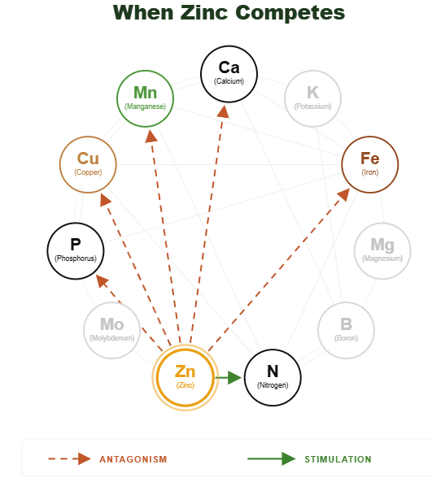 High phosphorus availability can reduce zinc uptake. Across a meta-analysis of 51 studies, phosphorus application reduced grain zinc concentration by 16.6% in wheat and 20.2% in maize.
The important question is why.
The evidence in the brief points toward the root zone rather than simply phosphorus and zinc forming an insoluble compound in the soil. Phosphorus application was associated with reduced mycorrhizal colonization, which can affect the biological pathways involved in zinc acquisition.
That matters because nutrient availability is not just a chemistry problem.
It is a soil–root–microbe system.
The Soil Academy's guide to how soil microbes drive nutrient availability goes deeper into the biological processes influencing nutrient cycling and release.
The Same Interaction Does Not Create The Same Risk Everywhere
Crop and rotation matter. Wheat, corn, pulses and flax can form mycorrhizal associations. Canola does not.
That means the same P–Zn interaction can have different implications depending on what is growing in the field and what came before it.
The Soileos Crop Guides put nutrient behaviour into that crop-specific context, while the Zinc Deep Dive looks more closely at the nutrient itself.
So What Should You Look At?
Before reaching for a higher micronutrient rate, consider:
Soil chemistry: pH and organic matter can strongly influence micronutrient availability.
Nutrient balance: phosphorus should be considered alongside zinc rather than as an isolated soil-test value.
Crop and rotation: uptake pathways differ between crops.
Release mechanism: when does the nutrient actually become available relative to crop demand?
That last question is increasingly important in nutrient planning.
A nutrient applied on the right date can still be unavailable when the crop needs it.
Go Beyond The Arrows
Mulder's Chart tells us that nutrients interact. The agronomic challenge is determining which interaction matters on this field, for this crop, under these conditions.
That requires looking beyond the nutrient number and into the system controlling access.
Explore the Soileos Soil Academy to dig deeper into nutrient availability, soil biology, micronutrients and crop-specific risk.
Then run your Soil Analysis Report to identify where nutrient risk may be hiding in your fields.
Know the interaction. Find the constraint. Plan for access.
