
Two fields come back from the lab at 1.2 ppm zinc. Same crop, same rate, same season. One responds to a zinc application. One does not.
Nothing went wrong at the lab. The number was never a measure of what your crop would get.
A soil test reports what an extractant pulled out of a sample under standard conditions. For prairie micronutrients that is usually DTPA, a chelate that strips a labile fraction of zinc, manganese, iron and copper off soil surfaces. A useful index, not an inventory of plant-available nutrient sitting in your root zone waiting to be collected.
What your crop actually gets depends on access.
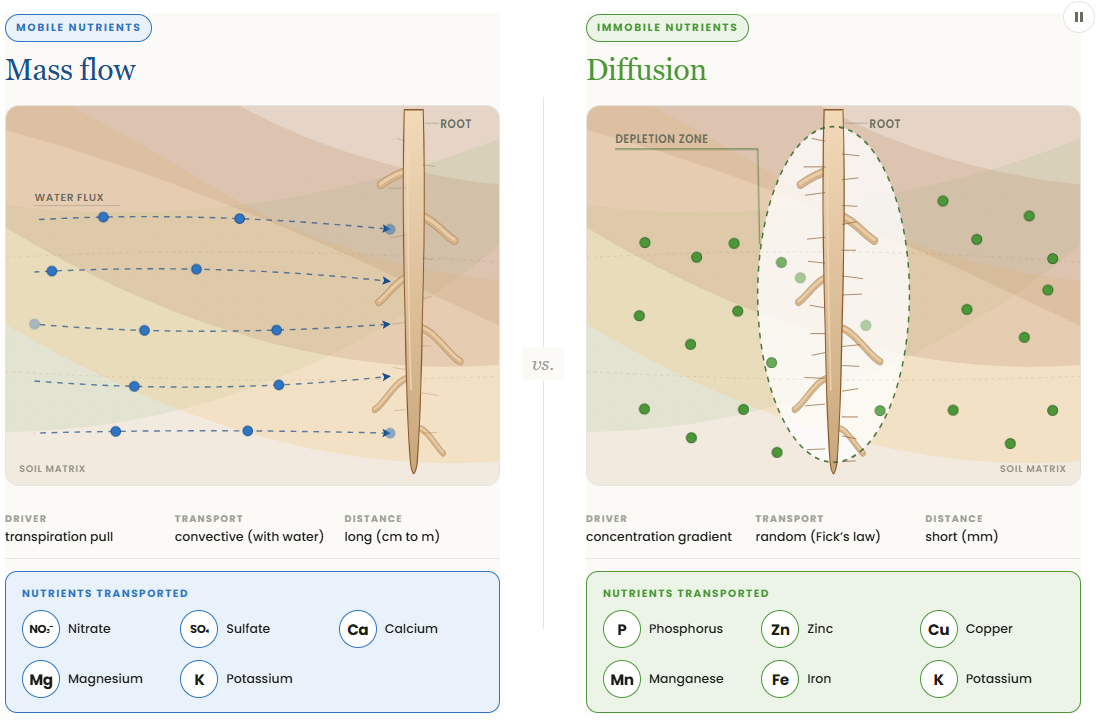
Zinc, manganese, iron and copper reach roots mostly by diffusion, moving a millimetre or two down a concentration gradient into the zone the root has already depleted. That process is slow, distance limited, and it stops when the soil dries or the roots stop exploring. A compaction layer, a cool spring, a dry seedbed, a pH above 7.5, or a heavy phosphorus load will all widen the gap between the number on your report and the amount that arrives at a root.
This is why the sites that respond in field trials are not only the deficient ones. In our own trial work, fields testing squarely in the adequate range have still returned measurable yield gains, because the constraint was never how much was present.
It is also why raising the rate is usually the wrong lever. Recovery of applied zinc fertilizer runs under 1 percent. More product does not shorten the distance a nutrient has to travel.
Presence is what your test measures. Access is what your crop is paid on.
Read the full breakdown: Why Soil Test Levels Don't Match Crop Uptake
It all starts with a Soileos test.
