---
title: "Hot Take: Farming Outside The Sweet Spot"
description: Discover how biological nutrient delivery can enhance crop performance on variable soils, moving beyond traditional chemical methods to improve consistency and efficiency.
image: https://blog.soileos.com/hubfs/Hero-1.png
---
[](https://blog.soileos.com)
- [Products](https://soileos.com/products/)
- [Product Overview](https://soileos.com/products/)
- [Soileos Boron + Zinc](https://soileos.com/products/soileos-boron-zinc/)
- [Soileos Copper](https://soileos.com/products/soileos-copper/)
- [Soileos Iron](https://soileos.com/products/soileos-iron/)
- [Soileos Manganese](https://soileos.com/products/soileos-manganese/)
- [Soileos Zinc](https://soileos.com/products/soileos-zinc/)
- [How It Works](https://soileos.com/how-it-works/)
- [Performance](https://soileos.com/performance/)
- [Trial Data](https://soileos.com/trialdata/)
- [ROI Calculator](https://soileos.com/roi-calculator/)
- [Soil Health](https://soileos.com/soil-health/)
- Resources
- [Blog](https://blog.soileos.com)
- [Events](https://soileos.com/events/)
- [Podcast](https://soileos.com/the-back-forty-broadcast/)
- [Soil Academy](https://soileos.com/soil-academy/)
- [Soil Academy](https://soileos.com/soil-academy/)
- [Agronomic Foundations](https://soileos.com/soil-academy/#agronomic-foundations)
- [Micronutrient Deep Dives](https://soileos.com/soil-academy/#micronutrient-deep-dives)
- [Crop-Specific Guides](https://soileos.com/soil-academy/#crop-specific-guides)
[Where to Buy](https://soileos.com/find-a-retailer/)
# Hot Take: Farming Outside The Sweet Spot
If there was one theme that came through loud and clear in our recent *Farming Outside the Sweet Spot* [webinar](https://www.youtube.com/watch?v=NgbWyrWrjcI&feature=youtu.be), it was this:
**Most growers aren’t farming textbook soil.**
They’re farming variability.

Across Western Canada and the U.S. Great Plains, fields routinely deal with:
- high or low pH
- sand and clay in the same quarter
- organic matter extremes
- slope and moisture variability
And yet, many fertility programs are still built as if every acre behaves the same. That disconnect is where frustration starts, and where micronutrients often get labeled as “snake oil.”
## The Micronutrient Trust Problem
During the session, Jason McNamee put words to a pattern many agronomists and growers recognize:
*“Soil test shows a deficiency, Product gets applied, Tissue test doesn’t move, Yield response is disappointing”*
At that point, confidence drops. But as Peter Gross reminded, the element itself isn’t the issue.
*“Zinc is an element on the periodic table… it does what zinc does.”*
When results fall short, the real question becomes:
What actually broke, the nutrient or the delivery system?
## The Reality of Salt Based Delivery
Traditional micronutrients (sulfates, oxides, and many chelates) rely heavily on water solubility.
That creates a timing mismatch.
As Jason explained, salts dissolve whenever the soil is wet, **not necessarily when the crop needs nutrients most.**
Once dissolved, those nutrients are exposed to soil chemistry and can:
- react with carbonates
- precipitate with phosphorus
- bind to clay
- or leach in sandy soils
Jason summed it up bluntly:
Applying soluble micronutrients can become a “hope strategy” hoping the root finds the nutrient before the soil ties it up.
Hope is not a fertility program.
## Why the Sweet Spot Is so Hard to Hit
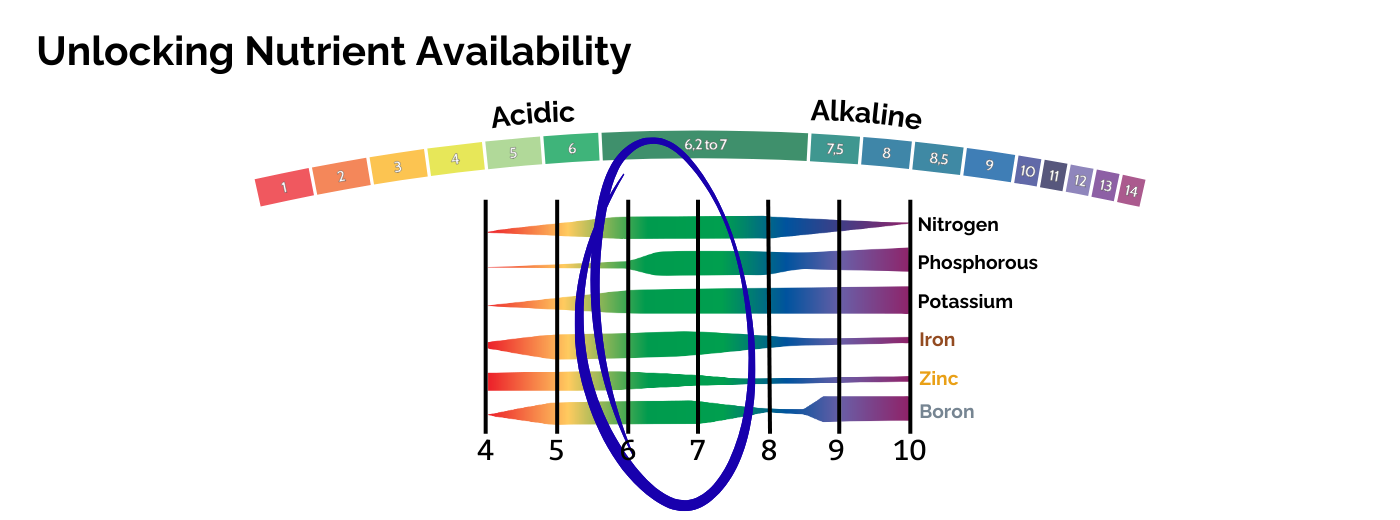
Textbooks often cite a pH sweet spot around 6 to 7 for optimal micronutrient availability.
The problem?
Very few growers farm in that narrow window.
In parts of Western Canada, Jason noted soils commonly run **pH 7.4 to 8.4**, where micronutrients like zinc can show adequate levels on a soil test but still remain unavailable to the crop. ([Read more about how to fix pH Failures with biology](https://blog.soileos.com/fixing-high-ph-failures-with-biology?hsLang=en-ca))
And pH is only part of the story.
Texture creates its own set of challenges:
- **Sandy soils:** nutrients can move too quickly (like a sieve)
- **Clay soils:** nutrients can get tightly held (like a bank vault)
Same product. Same rate. Completely different outcome.
## Where Biology Changes the Conversation
One of the central messages of the webinar was that **nutrient delivery doesn’t have to rely solely on chemistry.**
Before modern fertilizers, crops still accessed micronutrients through natural soil processes. Today, those same biological pathways remain active.
[Soileos](https://soileos.com/how-it-works/)is designed to work with that system.
As discussed during the session, nutrients in Soileos are bound to a cellulose-based carbon matrix. Soil microbes consume the carbon for energy and, through microbial mineralization, release nutrients in plant-available forms.
The practical implication:
- delivery is biologically timed
- less dependent on soil pH
- less exposed to rapid tie-up or leaching
Or as Jason put it:
*“It’s way easier to change the fertilizer than to fix your pH across 5,000 acres.”*
## It’s Not Always Deficiency, Sometimes it’s Imbalance
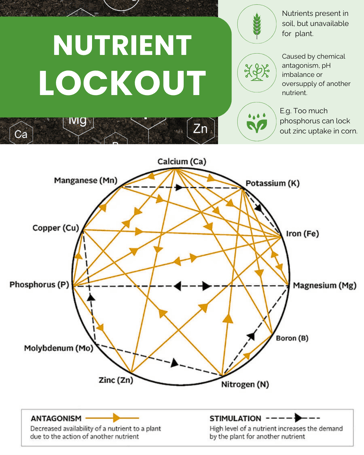
Another important discussion point was nutrient ratios. As yield targets climb, antagonisms become more common:
- Higher phosphorus can suppress zinc uptake
- Higher nitrogen without sulfur can stall protein formation
- High calcium in heavy soils can suppress potassium
In many cases, the issue isn’t that nutrients aren’t present, it’s that they aren’t accessible at the right time.
And when chemistry alone struggles to overcome those interactions, delivery method starts to matter more.
## Focus on the Acres That Need Help Most
One of the most practical takeaways from the webinar was Jason’s reminder that not every field needs the same solution.
“The goal isn’t to just buy more stuff.”
Instead, the focus should be on:
- stronger, more consistent yields
- better nutrient efficiency
- improved ROI per acre
Soileos tends to show the most impact in the areas growers know are toughest:
- high-pH zones
- sandy knolls
- heavy clay areas
- high or low organic matter fields
In other words… the acres outside the sweet spot.
## The Bottom Line
Perfect soil is rare.
Variability is normal.
And as crop nutrition programs evolve, the conversation is shifting from simply what nutrients are applied to how those nutrients are delivered and when they become available.
Because when you’re farming real acres, not textbook ones, consistency matters more than theory.
**Want to see how Soileos performs in your soil conditions?**
[Explore regional trial data](https://soileos.com/trialdata/)or connect with the team to discuss where biological delivery may fit your crop nutrition program.
[](https://blog.soileos.com/hs/cta/wi/redirect?encryptedPayload=AVxigLLy9J4%2FJOHCuygAYqBUkZfPPRCIR2iIsld8eEYlXpPBY%2FIy3uH7O5Y5hH2cScLSkePV82deCxW3Gzf4G4ass73USzJUqHa1HAdjhhnVg0SQ%2F%2FeojJQU4P0GgT%2FnrKvamOdg8Dx85EfQJI4zugjle8g9PL0qN9eNJoN46xULWf%2FBlRjolmFoR8EGAS1RzzNLZO7N%2F1D9iEu1h1PR3qVaRM8%3D&webInteractiveContentId=202731770934&portalId=9252743&hsLang=en-ca)
Watch the recording here:
#### Subscribe
###### [Devon Simpson Devon is a storyteller with a passion for sustainable agriculture, bringing innovative solutions to life.](https://blog.soileos.com/author/devon-simpson)
Share post on:
### [PREVIOUS POST Fixing High-pH Failures With Biology](https://blog.soileos.com/fixing-high-ph-failures-with-biology?hsLang=en-ca)
[Blog Home](https://blog.soileos.com)
### [NEXT POST 6 Season-Ready Decisions](https://blog.soileos.com/6-season-ready-decisions?hsLang=en-ca)

Soileos is a developed by Lucent BioSciences, Inc. and manufactured by Soileos AGT Saskatchewan LP in Rosetown, SK.
Lucent BioSciences, Inc.
207-1425 Marine Drive
West Vancouver, BC V7T 1B9
Soileos AGT Saskatchewan LP
Rosetown, SK
[**Contact Us**](https://hello.lucentbiosciences.com/get-started-with-lucent-bio)
- [Home](https://lucentbiosciences.com/)
- [How it Works](https://soileos.com/how-it-works/)
- [Products](https://lucentbiosciences.com/products/)
- [Performance](https://lucentbiosciences.com/trialdata/)
- [Soil Health](https://soileos.com/soil-health/)
- [Company](https://lucentbiosciences.com/)
- [Where To Buy](https://soileos.com/find-a-retailer/)
[Subscribe](https://lucentbiosciences-9252743.hs-sites.com/newslettersubscription?hsLang=en-ca)
© 2026 Lucent BioSciences, Inc.
[Privacy Policy](https://soileos.com/privacy-policy/) [Terms and Conditions](https://soileos.com/terms-and-conditions/)
```json
{
"@context" : "https://schema.org",
"@type" : "BlogPosting",
"author" : {
"@type" : "Person",
"name" : "Devon Simpson",
"url" : "https://blog.soileos.com/author/devon-simpson"
},
"dateModified" : "2026-03-03T14:30:00.552Z",
"datePublished" : "2026-03-03T14:30:00.000Z",
"headline" : "Hot Take: Farming Outside The Sweet Spot",
"image" : [ "https://blog.soileos.com/hubfs/Hero-1.png" ],
"mainEntityOfPage" : {
"@id" : "https://blog.soileos.com/hot-take-farming-outside-the-sweet-spot",
"@type" : "WebPage"
},
"publisher" : {
"@type" : "Organization",
"logo" : {
"@type" : "ImageObject",
"url" : "https://blog.soileos.com/hubfs/Soileos_HORI_RGB-4.png"
},
"name" : "AGT Soileos"
}
}
```